
Houston is often described as a city of roads, towers, and concrete. It is a sprawling metropolis seemingly built for speed, growth, and expansion.
But just beneath the surface lies another truth. Houston is a city born of water, shaped by it, nourished by it — and often tested by it.
For thousands of years, its bayous have served, in turn, as lifeline, trade route, cultural anchor… and threat.
This is the story of that complex relationship — one of attraction and challenge, opportunity and catastrophe.
At the Beginning: When Water Drew the Future
Nearly 18,000 years ago, long before the word Houston existed, geological forces were already determining the fate of the region. As glaciers receded, Buffalo Bayou carved its slow, winding path from present-day Katy to Galveston Bay. Fed by tributaries such as White Oak, Brays, Sims, and Greens Bayou, it became a liquid artery connecting inland Texas to the Gulf.
The land surrounding it quickly became a place where life could root itself.
And the first inhabitants understood that immediately.
Living With Water: Early Peoples and the Bayou
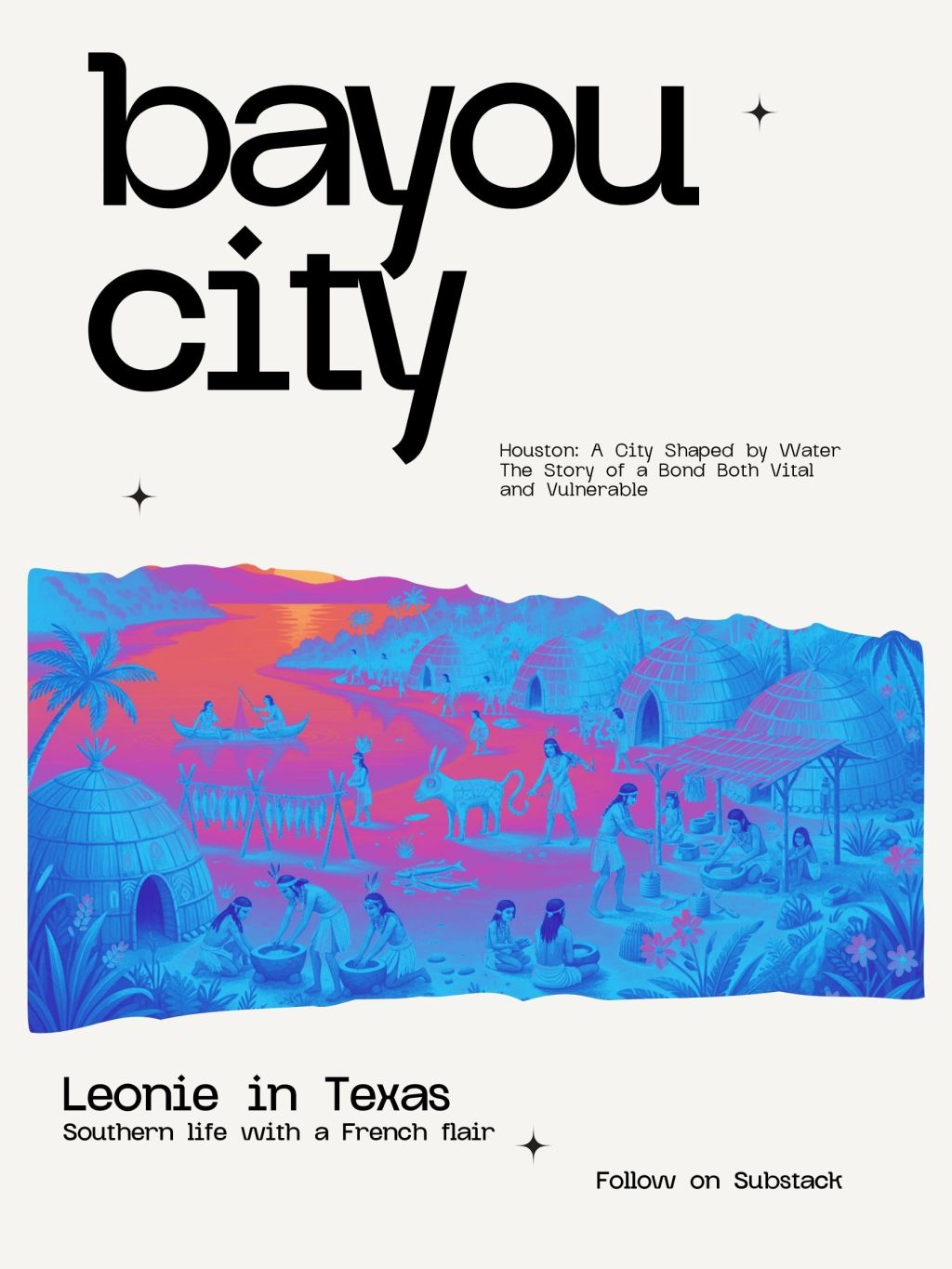
Around 2,000 years ago, the Akokisa and other Indigenous groups (Karankawa, Atakapa-Ishak, Coahuiltecan) organized their entire way of life around these slow-moving waters.
The bayou dictated the seasons, the movements, the resources.
Canoes slipped silently along its banks.
Camps shifted with the floods.
Fish, shellfish, and game were plentiful.
For these communities, water was a capricious ally — but an essential one.
This harmony left few architectural traces, but it etched one enduring truth onto the land:
you can only live here by learning to live with the water.

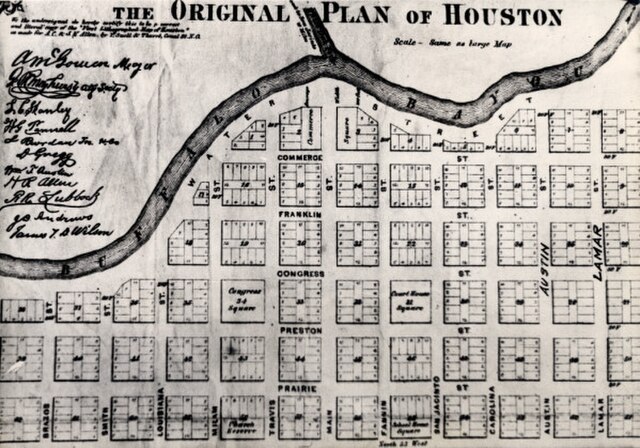
1836: The Allen Brothers and the Bet on the Bayou
When the Allen brothers arrived in Texas to found a city, they followed the same instinct as those before them.
They chose the exact confluence where White Oak Bayou meets Buffalo Bayou.
Why here?
Because water brought together everything a young city could hope for:
- a navigable waterway,
- a natural link to the Gulf,
- fertile land,
- and a smooth commercial route for timber and cotton.
Houston was not built near the bayou —
Houston was born from the bayou.
For decades, steamboats carried crops, supplies, and fortunes along these waters. And when the Houston Ship Channel opened in 1914, the relationship deepened even further:
The city anchored itself to global trade, dependent on the liquid artery that shaped every one of its choices.
Water was wealth. Water was power.
But Water Was Also a Threat: A City Built on Fragile Ground
What early inhabitants understood instinctively, 20th-century urban planners sometimes forgot:
You cannot tame a bayou — and even less a hydrological system this vast.
Houston sits on clay-rich soil that holds water.
On land so flat it barely drains.
And the city expanded far faster than its infrastructure could keep up.
The love story grew complicated.
Houston discovered — sometimes brutally — the other face of its bayous:
- Allison (2001), turning whole neighborhoods into lakes,
- The Tax Day Flood (2016), exposing the system’s fragility,
- Harvey (2017), a collective trauma and a sharp reminder of water’s power.
Each flood told the same story:
A bayou is not scenery — nor an oversized gutter.
It is a living, ancient, unpredictable system.
Learning to Live Together Again: A City in Constant Negotiation With Water
After decades of trying to straighten it, channel it, or ignore it, Houston slowly returned to an older wisdom:
Work with the bayou, not against it.
This shift in mindset gave rise to new ways of imagining the city:
- restoring natural curves and slopes,
- creating retention-parks that double as green spaces,
- preserving and re-creating wetlands,
- elevating homes and rethinking architecture,
- designing public areas that expect to flood safely.
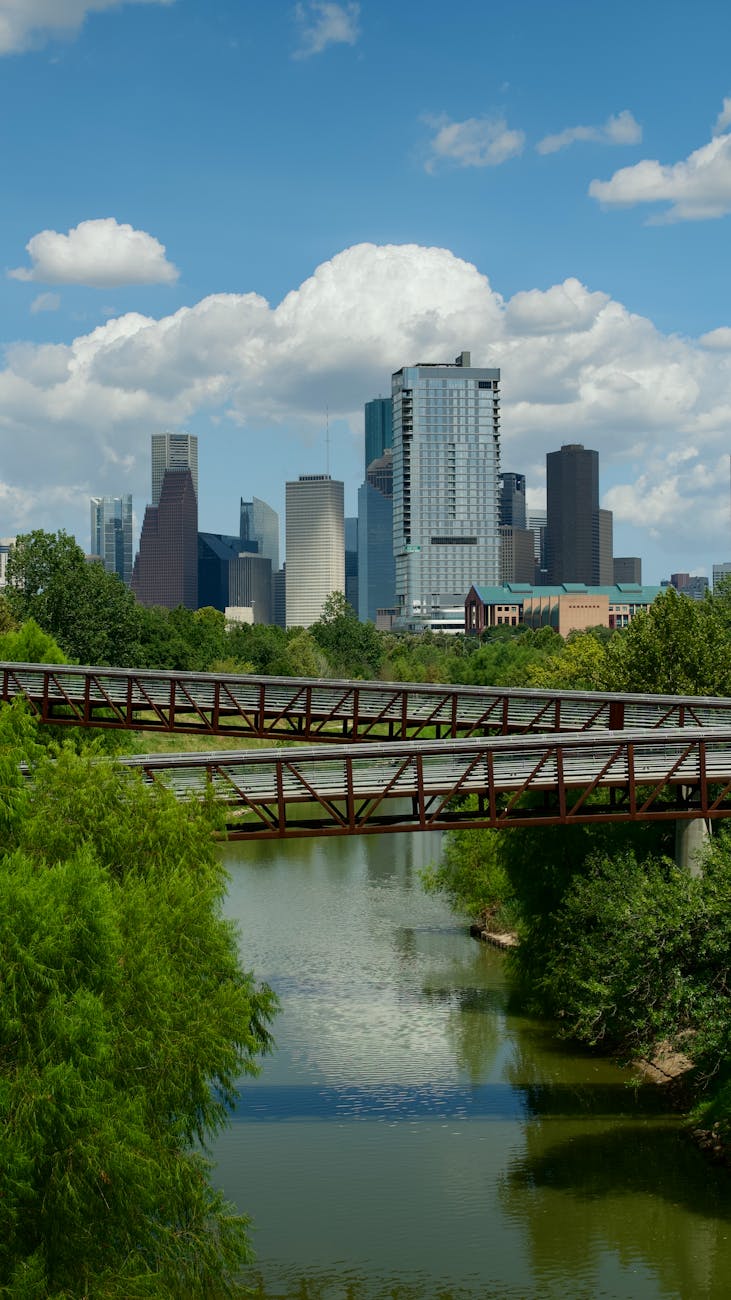
Projects like Buffalo Bayou Park embody this renewed harmony:
a beautiful public space — and a massive buffer capable of absorbing millions of gallons during a flood.
Love and fear meet here, in a fragile equilibrium.
Water as Visual and Cultural Identity
Over time, Houston has begun to rediscover the aesthetic and social potential of its bayous.
They shape urban perspectives.
They connect neighborhoods and parks.
Trails weave around them.
People kayak through downtown.
Wildlife sanctuaries emerge along restored edges.
Water becomes connection, beauty, breathing room.
Conclusion: A Story of Enduring Attachment
In Houston, water is never just water.
It is at once:
- origin,
- resource,
- inspiration,
- danger,
- and horizon.
The bayous gave birth to the city, enriched it, tested it, and forced it to reinvent itself.
And they continue, even today, to influence every decision, every neighborhood, every vision of the future.
Houston is a city that has learned — sometimes painfully — that living here means constantly negotiating with water.
To respect it.
To listen to it.
And, when storms arrive, to remember that this ancient bond is made of both fragility and strength.
Because here, water is not a background element.
It is the main character.
 Leonie Magazine
Laisser un commentaire